
Arholma → Landsort
There is something difficult to explain about One Water Race.
It is not simply the distance. It is not running. It is not swimming. It is not even darkness.
It is a combination of everything — for more than two days — while trying to make the right decisions with an exhausted body and an increasingly tired mind.
For Team 6, the journey to Landsort would take 56 hours. And it would become a story of teamwork, navigation, exhaustion, uncertainty, humour, setbacks and an extraordinary amount of stubbornness.
ARHOLMA
We arrived at Arholma excited and confident in what our team could achieve. With our previous experience, we had several possible routes planned so that we could get off the blocks quickly. Our plan was simple: find our pace, create a flow through the transitions and stick to it, regardless of what the other teams were doing.
The start went off. CP1 was identified, and our plan was in motion.
We moved through the first islands relaxed and confident. We knew that, going into the race, we were perhaps not the team that would run the fastest or swim the fastest — but we were not far off. Our advantage would be the flow: moving efficiently, making good decisions and taking care of each other.
Up to CP1B, five teams were close together. We were the fourth or fifth team to touch the checkpoint, but we were first into the water, with a small gap to the second team.
On the mainland at Kapellskär, several teams were still close. It was time to get dialled in. No rush. Just do the right things.
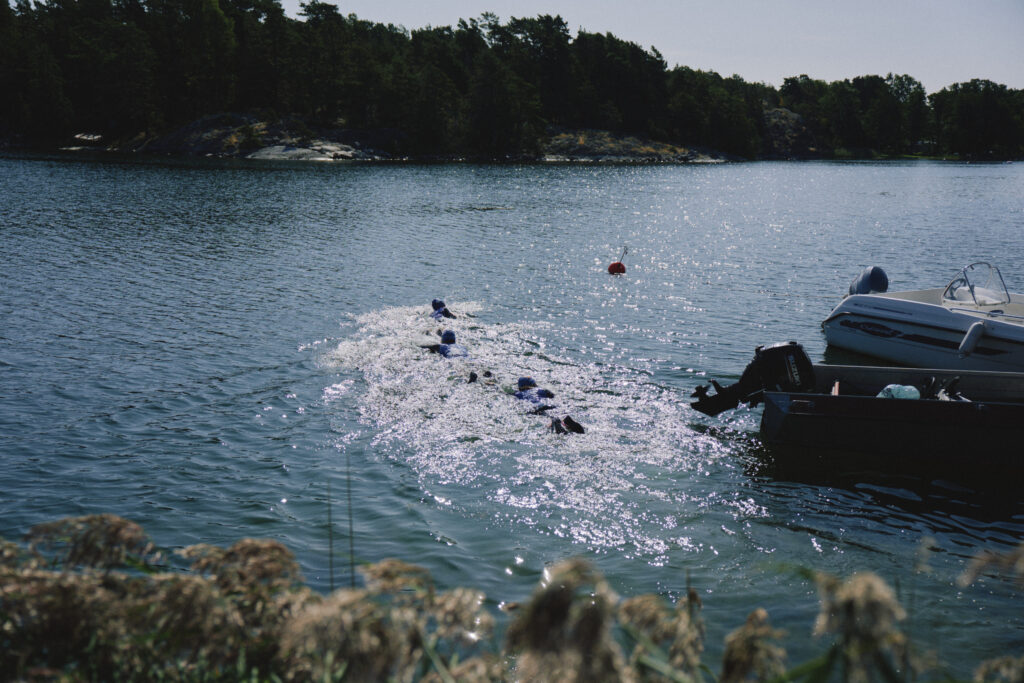
We prepared for the first proper swims towards Yxlan. The passage at Ålandet was rough and not our best, so we were soon side by side with Team 1 again. No stress, no worries — just keep going. As the water became calmer, we could really use our advantage of having two strong swimmers, Alexander and Rickard, capable of taking the lead.
CP2 was reached together with several teams, all within minutes of each other.
YXLAN AND FURTHER SOUTH
From CP2 onwards, we suddenly found ourselves alone. It was surprising, because until this point most of the teams had been moving together.
But the instruction remained the same: just keep your feet moving.
But the instruction remained the same: just keep your feet moving.
After Yxlan, we lost some of our flow. The first swim in complete darkness was done, along with several smaller jumps in and out of the water. We reached CP3 and saw several teams again. It was time to put on some gear for the night shift.
While we were doing that, Team 1 came swimming into the checkpoint. We wondered which route they had taken. But there was no time to dwell on it. We would check afterwards. Fun!
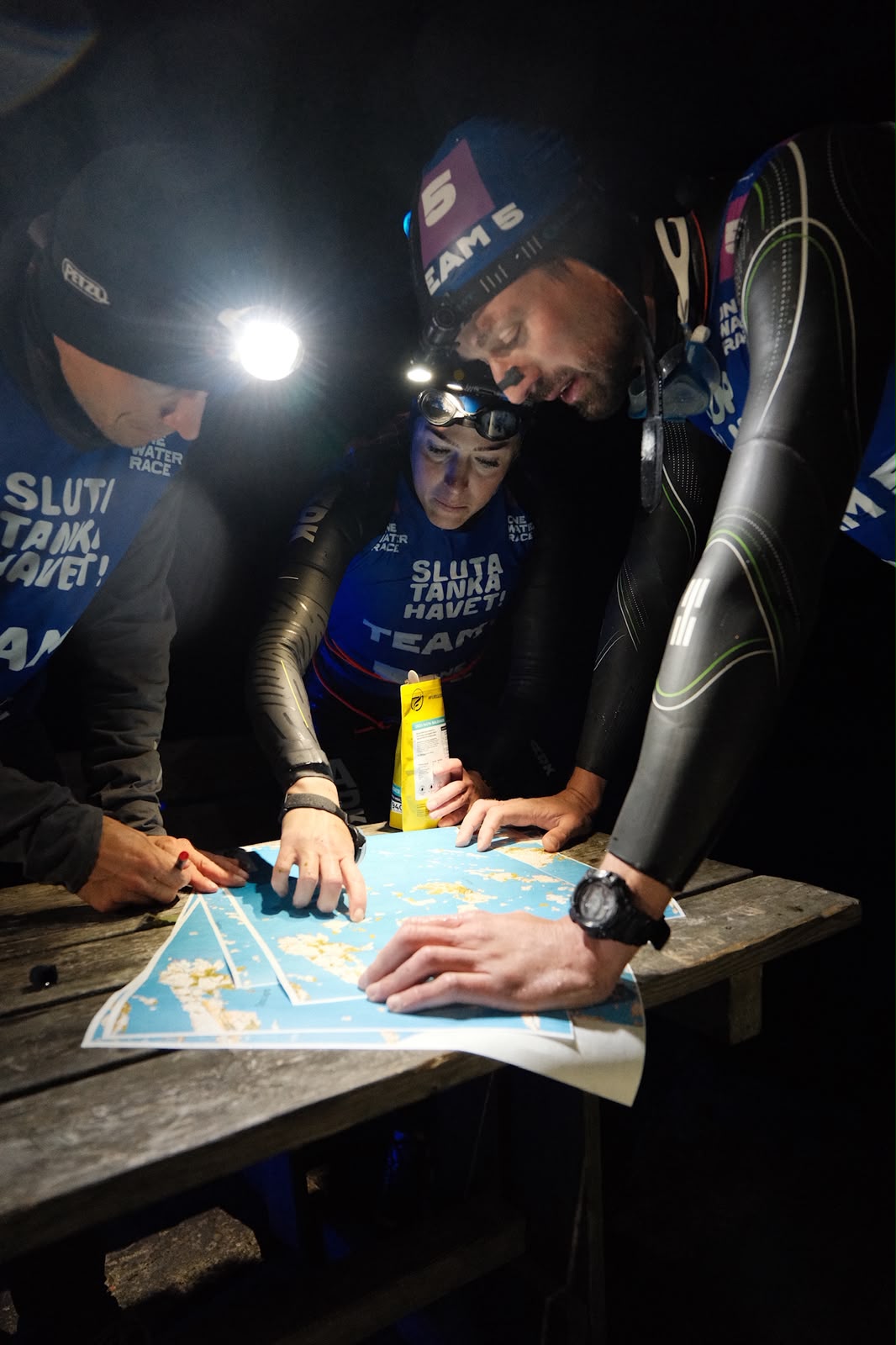
Marika was right on point with the maps and the route, leaving nothing to doubt. She gave the team exactly the information we needed to know so that we could prepare for the next coming part. No lack or too much information, just the right amount.
Then came the first night.
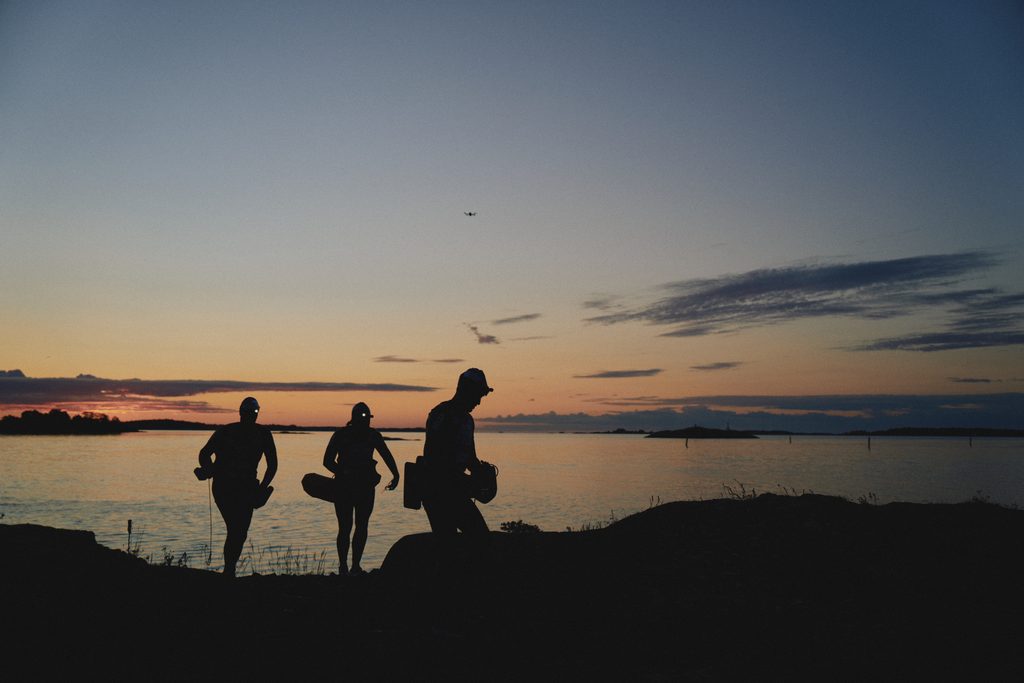
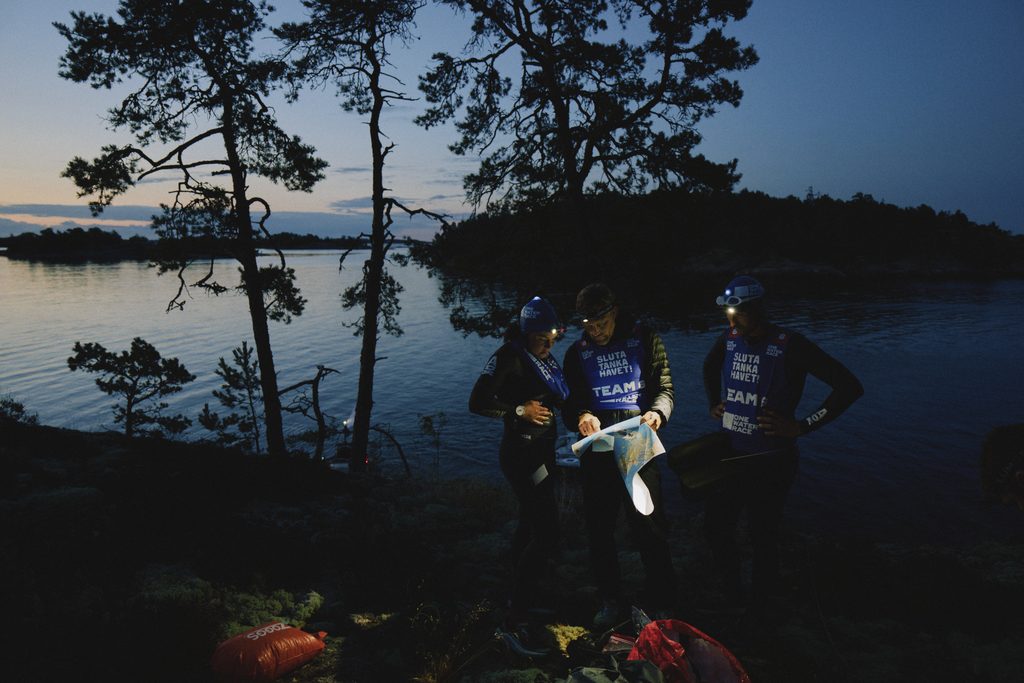
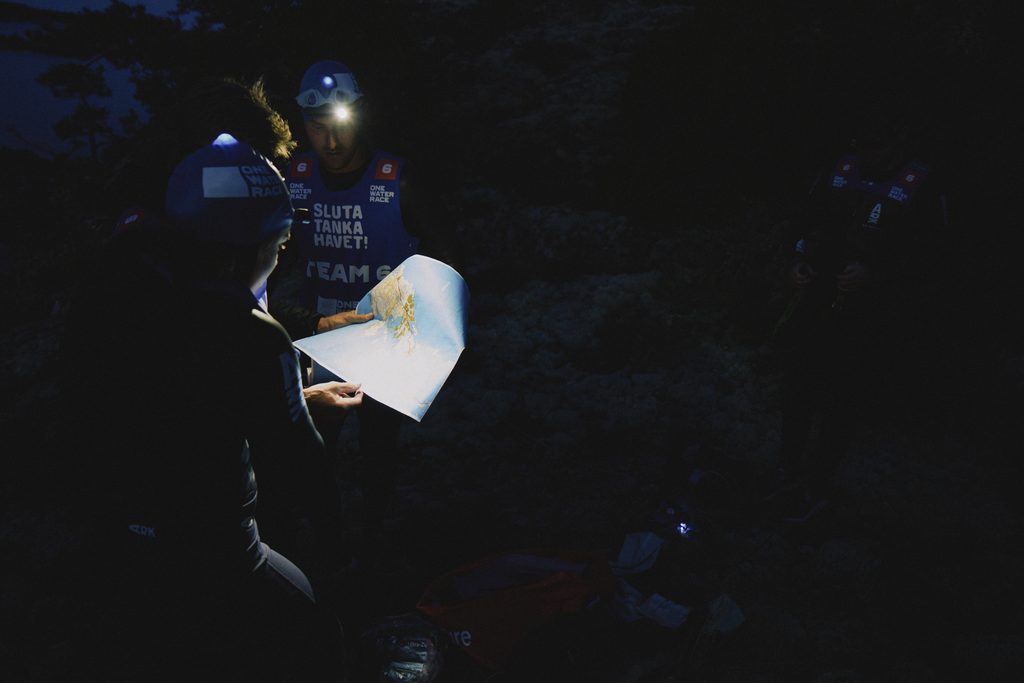
Darkness changes the character of the race. The archipelago that looked relatively familiar during daylight becomes a completely different world. The headlamps become the team’s horizon. The map becomes more important. The water becomes darker. Every navigation decision carries more weight.
This is where the race starts to become something else. It is no longer simply an endurance event that happens to last a long time. It becomes an expedition.
We moved through the night and reached the first rays of light down at CP5.
THE HELL ISLANDS
Now we were at the notorious “Hell Islands”. Before the race, we talked about these islands and how being there in daylight, compared with previous years, could make us too relaxed. Familiarity can be dangerous. It can make you stop paying attention.
So, the focus was simple: stay sharp, navigate properly and do the right things.
CP6B was reached knowing that our passage from CP5 to CP6B might not have been the fastest in the race, but it was solid and we maintained our flow. CP7 came quickly, and we felt that we were through the worst parts.
On the island at CP8, we made a small navigation error. It did not cost us much time, but it was a reminder that there was no room to switch off.
On the island at CP8, we made a small navigation error. It did not cost us much time, but it was a reminder that there was no room to switch off.
Robert met us on the same island for a status check. To our big surprise, we also met Julian. From our position at CP5, and from how we felt we had progressed since then, we believed Team 1 should have been 10–15 minutes ahead of us.
Julian asked if we had seen his team. Unfortunately, we did not.
Five to ten minutes later, we met the Australian team backtracking towards CP8. A focused recognition was exchanged by everyone.
We were now on familiar ground from previous years. Teams with experience could use that knowledge in daylight to push the pace and gain or make up time. We still focused on ourselves and kept the flow going.
A short break was needed to let a ferry pass the boat route from Sandhamn.
At this point, we were in a good place. No major hiccups. We felt strong, in control and focused on the next task. CP9 was reached.
THE FIRST REAL LOW POINT
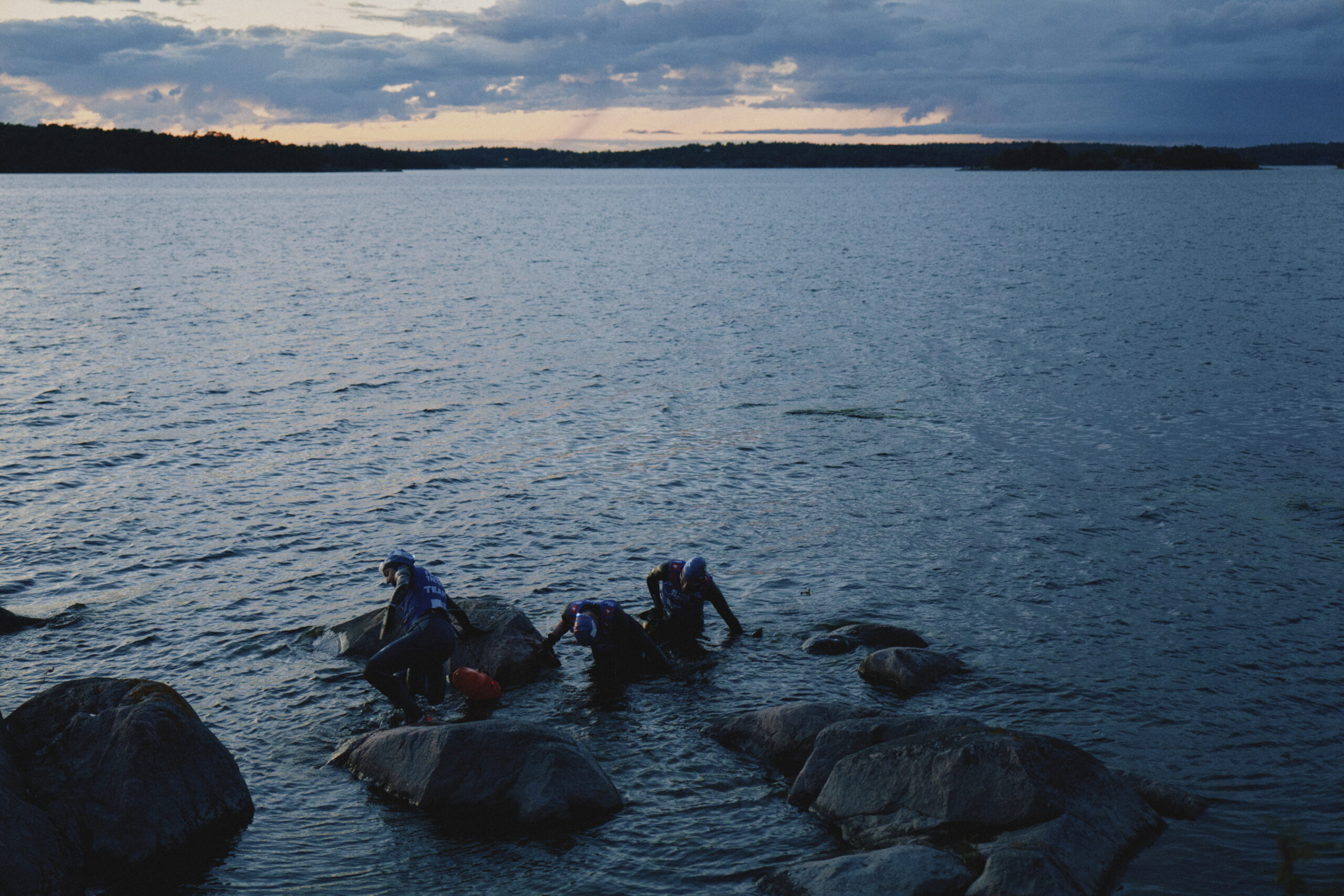
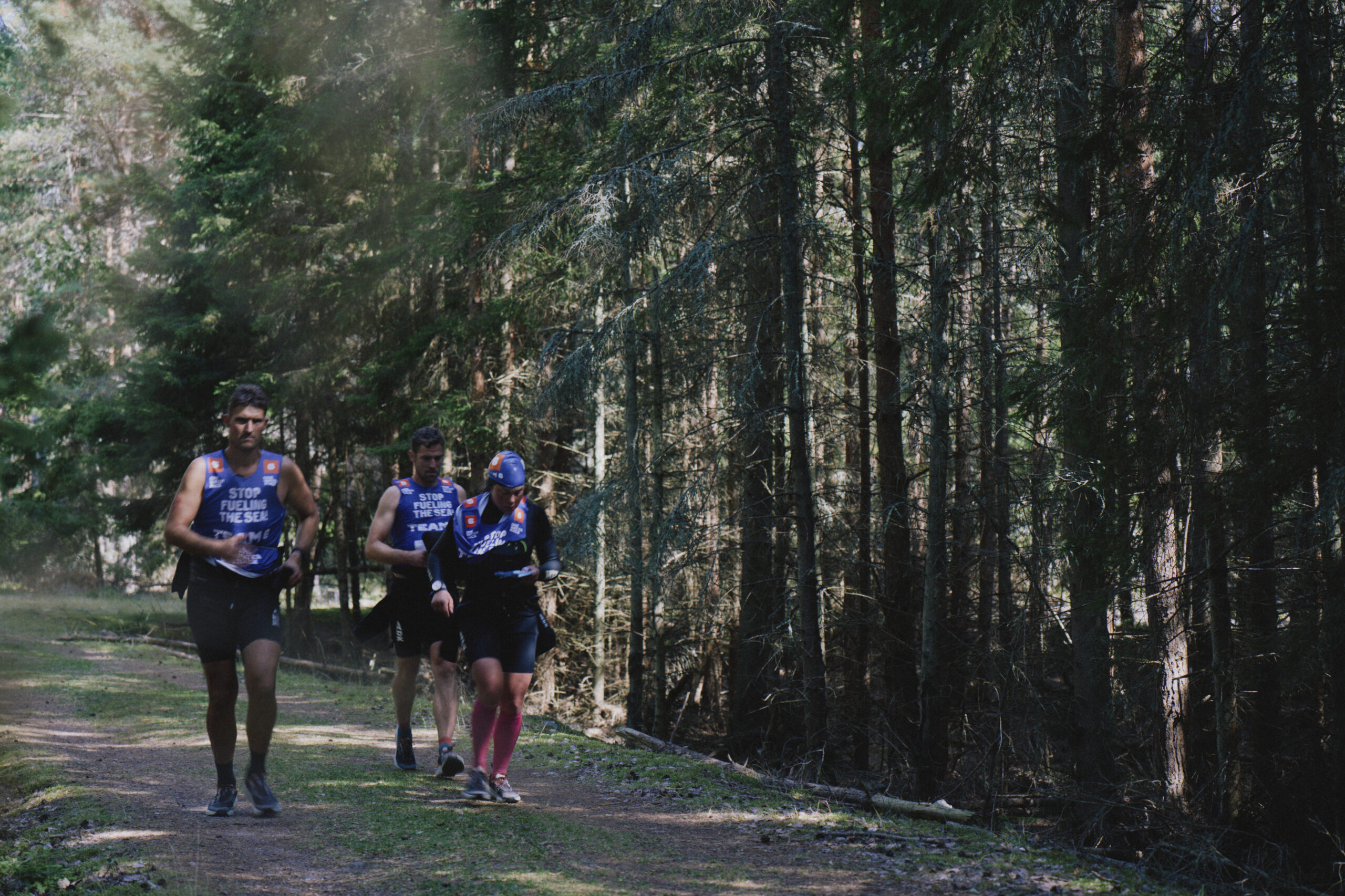
The swim from CP9 was the first time we came out of the water with a light touch of shivering. But getting to Runmarö gave us a longer run and the opportunity to recharge with sunlight, energy and some socialising within the team. We quickly became warm again — in heart, body and mind.
Then came the famous CP10.
We could not find the blue checkpoint box. We were certain we were in the correct position according to the map and double-checked with Robban on land. Within minutes of leaving CP10, we noticed the blue checkpoint box. To be on the safe side, we decided to go back and touch it just in case.
We knew afterwards that this had cost us time. But at the time, it did not really matter. The only thing that mattered was the next task.
During the next jumps on and off the islands, we saw the Australians again. Fun — but again, focus on ourselves.
Now we were at Nämdö. We were approximately 24 hours into the race, not even halfway, and the second night was coming fast.
On the swim towards Jungfruskär, we saw them: the greatest supporters, filling the air with cheering and music.
Ängskär, Jungfruskär and Gillinge are familiar grounds, but they are still hard to navigate and slow to move through. Fatigue was beginning to influence the mind. It became harder to keep warm. Small errors were made, although nothing significant.
The swims had been positive so far, but on the swim from 12B the waves were hitting Rickard directly. The swim itself still went well, but a low point was beginning to arrive.
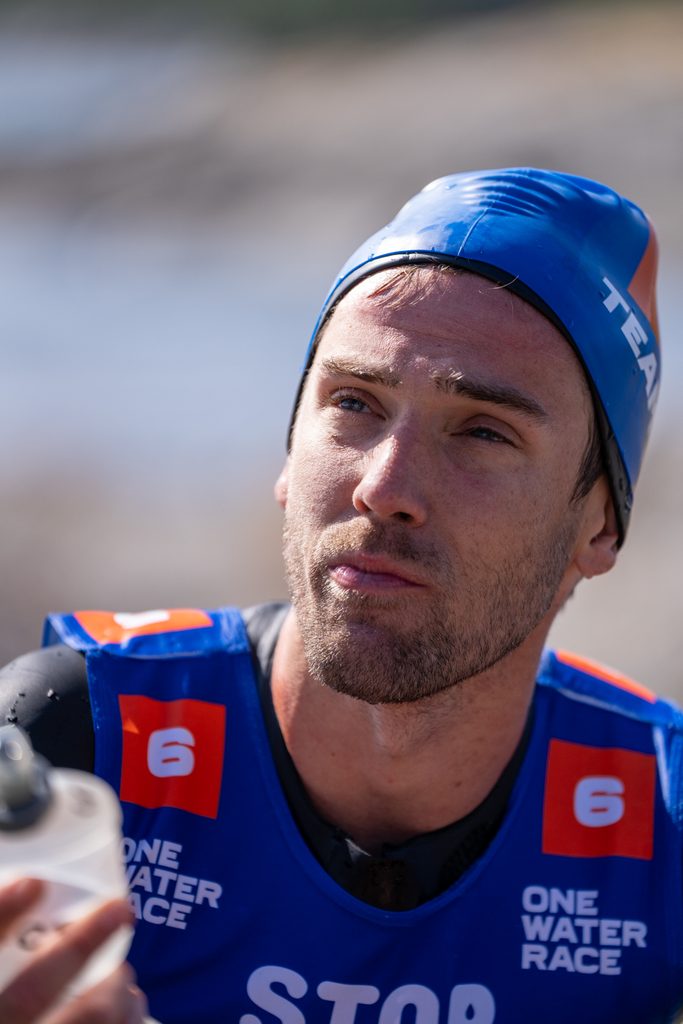
After the next swim, Rickard’s body was simply not functioning.
This is where the race becomes about the team.
After the next swim, Rickard’s body was simply not functioning. This is where the race becomes about the team.
One person can be struggling while another is still moving strongly. Someone needs encouragement. Someone needs food. Someone needs to slow down. Someone needs to keep everyone focused.
“Rickard, do you want to feel better? If yes, you need to take in energy and start moving!”
Marika said exactly what needed to be said.
With open and close communication, Marika and Robban were in control. We broke the task in front of us down into something Rickard could manage. Take in energy. Start moving. Get to the water. Do the next swim.
We were already down by the water for the last swim to Ornö.
CP13 was reached with confidence in the fact that we were there, but with a tear in it. Keep fueling. Keep your feet moving. Focus on the next task and do it as well as we can.
CP14 was reached with the knowledge that we had done a solid Ornö run. Not the fastest, but not slow.
As we left CP14, we had to backtrack for a short stretch. Alexander heard voices in the distance, so we made a quick decision: switch off our headlamps. We were in an area where navigation had already been difficult, and another team’s lights were visible further away. With our lamps off, we could keep moving without drawing attention to ourselves. Once we were back on safe ground, we switched them on again and continued towards Utö.
UTÖ AND THE SECOND DAY
Soon we were down on Utö for CP15.
At CP15, we met Ogander and a large media crew. We did not slow our pace but still found time to socialise. We had agreed with Robban to meet at the pier by Utö church.
It was time for lunch — one of the few moments during the race when we could sit down. Marika and Robban also needed to discuss the maps and the restrictions imposed by the military.
By now, the race had changed completely. We had been moving for more than 30 hrs going towards 40 hrs, and the finish was still far away.
Time becomes strange in a race like this. Morning arrives. Then afternoon. Then another evening. You stop measuring the race in hours. You measure it in sections.
One island at a time. One swim at a time. One checkpoint at a time.
And slowly, almost imperceptibly, the map behind you becomes larger than the map in front of you. You are getting closer.
At CP16 we were met by a fantastic view: boats anchoring in a beautiful bay with crystal-clear water.
The swim towards Rånö was expected to be cold because of the warmth we had built up on land.
CP17 and CP18 went past in a hurry without any major issues. Just keep going, even though the body hurts.
DANZIGER GATT
Then Danziger Gatt was approaching.
Almost out of nowhere, we were preparing for the long swim across Danziger Gatt. Rickard was the only member of the team who had not done this swim before, so we had a backup plan.
Alexander and Rickard had practised switching places during swims specifically to have this option available.
Rickard started swimming strongly but struggled to maintain the correct course. Robban told him more than three times that we were heading directly towards the restricted area. Rickard did his best to correct the course, but the outcome remained the same.
We took an energy break, knowing that the current would drift us and that we could use this to be better positioned for the second part of the swim.
Then Rickard and Alexander switched places.
Alexander hit the task full ahead, performing exactly what the team needed.
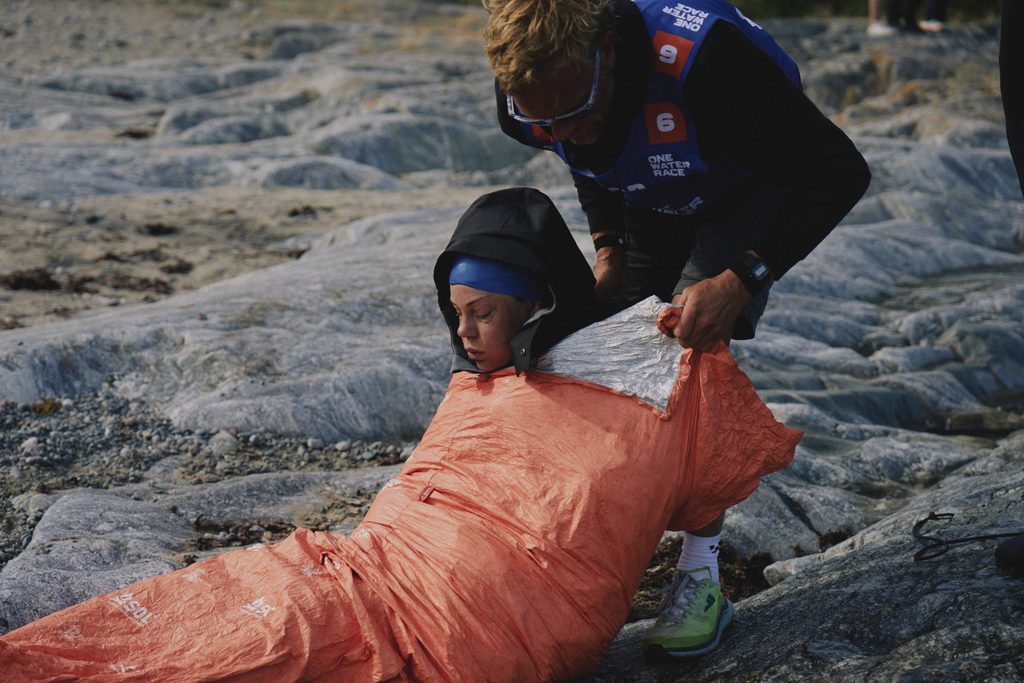
CP19. Land after Danziger Gatt.
Marika was cold and a little dizzy. Rickard and Alexander were also affected by the big swim and took a second or two before helping her back onto her feet. Then, just as quickly, we were back at it, solving the next task.
TOWARDS LANDSORT
The focus now was to cover as much ground as possible before darkness arrived.
It was hard and tough, but energy intake remained continuous. At Torö, the team connected a line between Alexander and Rickard. Alexander was strong enough to allow Rickard to push for more energy without losing the pace.
We reached the end of Torö with all the forest navigation done. Darkness arrived.
We were fatigued. We met Robban, who told us that the Australians had already finished and that the teams behind us were far away.
And then, in the distance, we could see the light from the lighthouse. For the first time, we relaxed enough to think: we are going to finish.
And then, in the distance, we could see the light from the lighthouse.
For the first time, we relaxed enough to think: we are going to finish.
And that was almost dangerous.
The edge we had maintained since the start disappeared slightly. We had been so focused on the next task for so long that seeing the lighthouse made the finish feel real. We became slower. The wind picked up. The darkness somehow seemed even darker than the previous nights.
But the lighthouse was there.
THE LIGHTHOUSE
At last, we reached Öja. After more than two days of moving through the archipelago, it was a relief to set foot on the island. But we were not finished yet. The lighthouse was still waiting, and we had one final stretch to cover.
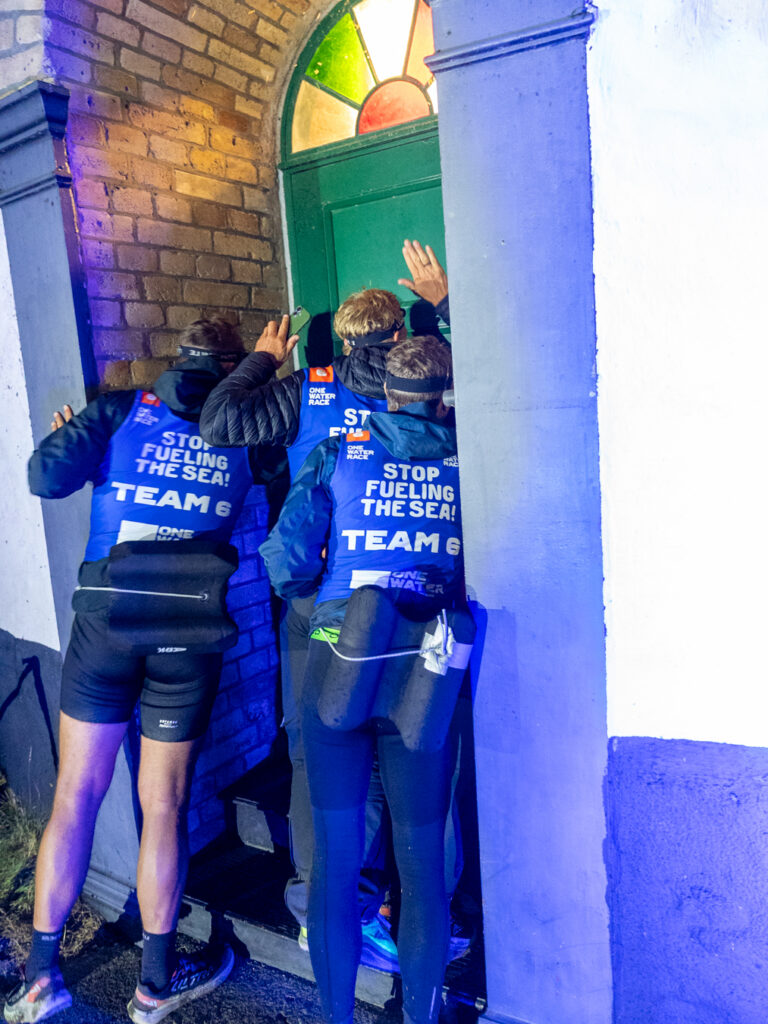
We made our way towards the finish, tired beyond anything we could easily put into words. Then the big green door came into view, along with the crowds waiting for us. After 56 hours of running, swimming, navigating and relying on one another, we had made it.
There was no next checkpoint to think about. No next swim to prepare for, no island to reach, no route to solve. For the first time since leaving Arholma, we could stop moving and take in what we had done.
We started as four people with a plan. We reached Landsort as a team that had carried one another through fatigue, uncertainty and the moments when the finish still felt impossibly far away.
The race was over. The journey was complete. And we could not have asked for a better ending.
REFLECTIONS
Could not have asked for a better team.
We had not completed a single training session as a whole team together before the race. Yet each one of us was confident and comfortable with the others.
Going into the race, we knew that our strengths were not what would be difficult to handle during the race. It would be our personal weaknesses.
With that knowledge, the only thing we could do was to be open and talk about relevant difficulties.
That was performed perfectly.
When one person struggled, the others stepped in. When someone needed energy, the team made sure it happened. When a decision had to be made, we communicated. When someone needed to change position in the water, we had already prepared for it.
These are the moments that never appear on the results table: the hesitation, the frustration, the fatigue, the small mistakes, the laughter at completely inappropriate moments, and the decision to keep going when stopping would have been so much easier.
This is where a team is tested.
And Team 6 kept moving.
Because that is what One Water Race ultimately becomes.
Not 250 kilometres. Not 56 hours. Not a finishing position.
It becomes four people depending on one another, repeatedly, until there is nowhere left to go.
Until the lighthouse is there.
And the race is finally over.
Arholma → Landsort
56 hours.
One unforgettable journey.